• Skip to primary navigation
  • Skip to main content
  • Texas A&M Forest Service
  • Texas A&M Veterinary Medical Diagnostics Laboratory
  • Texas A&M AgriLife Extension Service
  • Texas A&M AgriLife Research
  • Texas A&M College of Agrculture and Life Sciences
Working on Wellness Environments
Working on Wellness Environments (WOW-E) is a Texas A&M AgriLife Extension multidisciplinary community development program
  • Menu
  • Home
  • About
    • What is WOW-E
    • Meet the Team
    • Our PSE Approach
    • The HOP Program
    • HOP Counties
  • Stories
    • Blog
    • Videos
  • Resources
  • Technical Assistance
    • WOW-E Technical Assistance Process
    • WOW-E FY 2027 Technical Assistance Cycle
  • Become a WOW-E Community

Welcome to the Funny Farm!

November 19, 2020 by valeriejauregui

In Roma, TX, the Funny Farm is the pride of R.T. Barrera Elementary. Spearheaded by physical education teacher Mr. Rolando Munoz, the Funny Farm has expanded from a small garden to a 105 by 150 sq ft “farm”. The Eagle’s Orchard is the newest addition to R.T. Barrera’s Funny Farm.
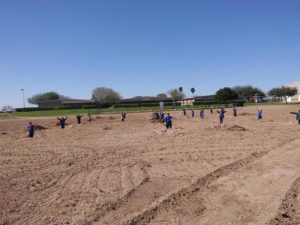
The orchard was established in January 2020 as part of a Starr County Farm to School initiative with the Working on Wellness Environments program and the Farm to School program. Partners such as Roma ISD, the students and staff at R.T. Barrera Elementary, Texas A&M Agrilife Extension, and the local community have helped sustain and move the orchard forward. The orchard includes 43 trees with 8 varieties of grapes, peaches, pineapple oranges, mandarins, limes, figs, grapefruits, and guava trees. Everyone at the school has a role, from food service staff to principals, and down to the students.

The Funny Farm began 9 years ago as a small school garden with just a few plants. The same practice of involving staff, parents, and students has been held to this day. The school attributes this, and constant support from administration as a way the garden has been sustained throughout the years.

Students are especially involved in the farm. They make sure the animals are well taken care of, feed them using measuring cups to make sure they get the right amount of food, harvest produce like lettuce and cucumbers, and make sure that produce goes back to the cafeteria. Additionally, students are allowed to take some of the produce home, where they can prepare a meal and bring it back for show and tell.
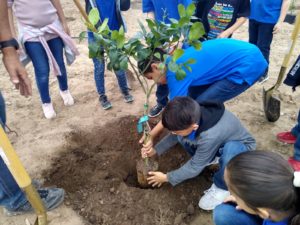
Through the farm, students learn agricultural and nutritional practices and introduces them to new fruits and vegetables. Trees in the orchard are watered through a drip irrigation system, and the amount of water depends on the season. The school allows visitors to visit the Funny Farm, where they can learn sustainability practices.

Volunteer involvement has been immense from planting trees to digging holes to pulling weeds. Surplus fruit will be sold at festivals, farmer’s markets, and ag clubs in order to ensure longevity. The farm is looking to adapt an adopt-a-tree program to help sustain the the orchard for many years to come.

With COVID-19- the “farm” has seen its challenges. With students not physically in school, garden maintenance has been done through school administrators themselves. The next phase for the farm is to add pollinator garden beds, and a high tunnel which have all been approved. The farm has also recently been awarded an NRCS grant to help cover costs. The main goal of this project is for Roma ISD to expand to other schools in the district. For more information, check out the video below!
 

Filed Under: Blog, Nutrition, PSE, Starr County Tagged With: Nutrition, Starr County

What is Farm to School?

October 16, 2020 by valeriejauregui

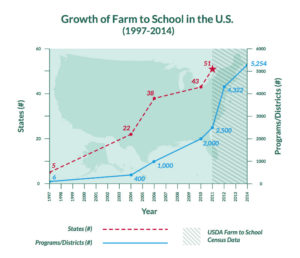
The Eagle’s orchard at R.T. Barrera has been partially funded by donations and most recently, as part of a Starr County Farm to School grant. The National Farm to School effort sprouted in 1996-1997 from the desire to support community-based food systems, strengthen family farms, and improve student health by reducing childhood obesity. In 2004, the National Farm to School Program was officially authorized, and included 400 programs in 22 states. The Farm to School Network was founded in 2007. The National Farm to School network’s first 

decade of efforts focused on developing a strong network of partnerships across sectors, building awareness about farm to school and increasing activities at the state and regional levels through training, capacity building, and policy advocacy.

Farm to school enriches the connection communities have with fresh, healthy food and local food producers by changing food purchasing and education practices at schools and early care and education sites. Like at R.T Barrera, students gain access to healthy, local foods, as well as education opportunities such as school gardens, cooking lessons and farm field trips. Farm to school empowers children and their families to make informed food choices while strengthening the local economy and contributing to vibrant communities

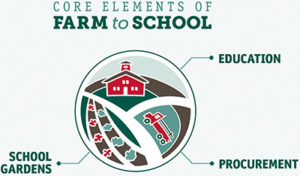
Farm to school implementation differs by location but always includes one or more of the following:
– Procurement: local foods are purchased, promoted and served in the cafeteria or as a snack or taste-test.
– School Gardens: students engage in hands-on learning through gardening; and
– Education: students participate in education activities to agriculture, food, health or nutrition

Today, there are 42,587 schools involved, 42% of US schools, 23.6 million students engaged, $789m spent on local food, 46 states with supportive policies, and 20,000+ nfsn members. To learn more, you can go here.

Filed Under: Blog, Nutrition, PSE, Starr County Tagged With: Nutrition, Starr County

Meeting Digitally

August 11, 2020 by valeriejauregui

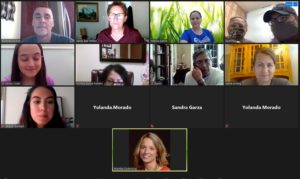
The COVID-19 pandemic has forced many of us to work differently. Whether it’s taking on a new or additional job or household responsibilities, quarantining at home or wearing facial masks and protective gear, we’ve all had to adapt to these unprecedented times. This also includes adapting our outreach for WOW-E and working with many groups to meet online.
After some initial time to adjust to COVID-19, some local coalition groups and the WOW-E team have been able to engage in planning meetings and coalition meetings online. Victorino Cantu, in Starr County, and the counting experts from TTI (Texas Transportation Institute) were able to “visit”, plan, and troubleshoot pre-use counts using Zoom, Google Earth, mapped cell phone images, email, and good old fashion phone calls.

Of course, these new changes come with challenges. Most of our coalition members are involved in frontline COVID-19 response efforts. Additionally, internet access and access to computers prohibited some from being a part of the efforts as mentioned by one of our groups in Webb county. Finally, some members may have no experience with zoom. While some have found asking their children and grandchildren for help has been helpful, and are on their way to becoming zoom professionals, others do no see this as the solution for themselves!

Please be reassured that we continue to work with our local agents and team members are listening to you all as we work together in responding to and adapting our outreach to continue to support local coalitions in the efforts to continue to push for healthier infrastructure and systems in your local communities. Know that you can reach out to me with questions, ideas, or concerns through my email valeria.jauregui@ag.tamu.edu or my direct phone line (956) 821-1476.

Filed Under: Blog, Connectivity, Nutrition, Physical Activity, PSE

February is Heart Month

February 6, 2020 by valeriejauregui

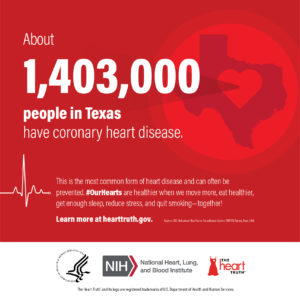
This month marks the 56th consecutive heart month initiative. According to the American Heart Association, heart disease is the number one killer in the United States. The initiative promotes the importance of heart health and the need for more research, with a reminder to get everyone involved. Cardiovascular disease (heart disease and stroke combined) kills about 2,300 a day. Obesity in both youth and adults is at an all-time high. The American Heart Association wants you to consider these facts:
  • Heart disease kills more people than all forms of cancer combined
  • Heart attacks affect more people every year than the population of Dallas, Texas.
  • 83% believe that heart attacks can be prevented but aren’t motivated to do anything.
  • 72% of Americans don’t consider themselves at risk for heat disease.
  • And 58% put no effort into improving their heart health.

While there have been advances in medicine, the AHA says unhealthy lifestyle choices combined with rising obesity rates in both kids and adults have hindered progress fighting heart disease.

“The good news is that heart disease is preventable in most cases with healthy choices, which include not smoking, maintaing a healthy weight, controlling blood sugar and cholestrol, treating high blood pressure, getting at least 150 minutes of moderate-intesity physical activity a week and getting regular checkups.”

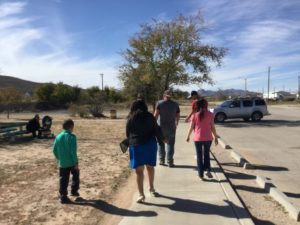
Working on Wellness Environments- Texas A&M Agrilife Extension is joining these efforts by promoting healthy foods and physical activity, supporting and providing technical assistance for the creation of local food systems, and working with local communities to create walkable downtowns and connecting safe, accessible areas to everyday destinations.
Tomorrow, February 7th, is National Wear Red Day! Go red for the awareness and prevention of heart disease. For more information, visit goredforwomen.org

Thanks to Dr. Jenna Anding for the resources!

Filed Under: Blog, Connectivity, Nutrition, Physical Activity, PSE

New Infographic for Nutrition, Physical Activity, and Obesity

January 8, 2020 by kcoats

By: Leah Shafer Glaser

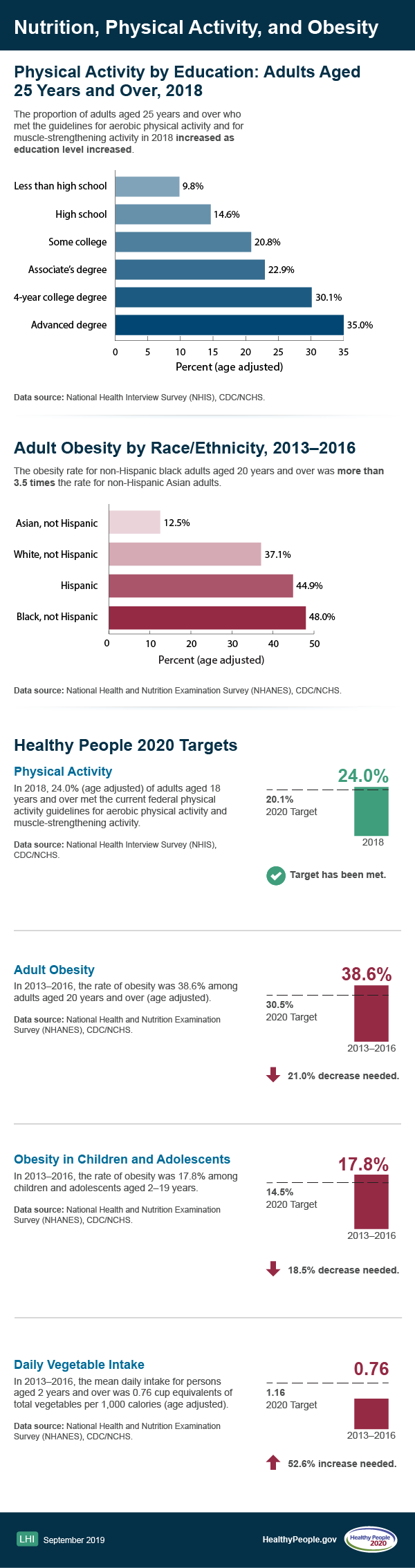
The CDC has developed Leading Health Indicators (LHI) as part of Healthy People 2020, communicating high-priority health issues and actions that can be taken to address them. Their most recent infographic addresses Nutrition, Physical Activity, and Obesity. It’s a snapshot of progress toward targets — and a place to see where there’s still work to be done. Let’s take a look (full infographic at the bottom of this post).

The first part of the infographic shows the relationship between educational levels and the proportion of adults over 25 who met the guidelines for aerobic activity and for muscle strengthening activity in 2018.

Second, the infographic breaks down rates of adult obesity by race/ethnicity from 2013 to 2016 across the United States. Among Asians, the rate was lowest, at 12.5%. White, not Hispanic, was 37.1%, Hispanic was 44.9%, and Black, not Hispanic, was 48%.

The CDC has Healthy People Targets as part of Healthy People 2020, and this part of the infographic looks at physical activity, where the target was met in 2018. During that year, 24% (age adjusted) of adults 18 years and over met the current federal physical activity guidelines and muscle strengthening activity.

The next part looks at adult obesity, where the goal was not met and a 21% decrease is needed. In 2013-2016 in adults aged 20 years and over (age adjusted), the obesity rate was 38.6%.

Among children and adolescents aged 2-19 years, in 2013-2019, the obesity rate was 17.8% An 18.5% decrease is needed to meet the Healthy People Target in this category.

Finally, the infographic looks at daily vegetable intake for persons aged 2 and over, where a 52.6% increase is needed to meet the Healthy People Target. The mean daily intake was 0.76 cup equivalents of total vegetables per 1,000 calories (age adjusted).

About the CDC Leading Health Indicators

The Leading Health Indicators are a subset of 26 Healthy People 2020 objectives that communicate high-priority health issues. These indicators can help assess the health of the Nation, encourage collaboration across sectors, and motivate action to improve the health of the U.S. population at the national, state, and community levels.

Nutrition, Physical Activity, and ObesityInfographic for Healthy People 2020

Filed Under: Blog, Nutrition, Physical Activity

  • Page 1
  • Page 2
  • Go to Next Page »
Texas A&M AgriLife Extension Service
Texas A&M University System Member
  • Compact with Texans
  • Privacy and Security
  • Accessibility Policy
  • State Link Policy
  • Statewide Search
  • Veterans Benefits
  • Military Families
  • Risk, Fraud & Misconduct Hotline
  • Texas Homeland Security
  • Texas Veteran's Portal
  • Equal Opportunity
  • Open Records/Public Information